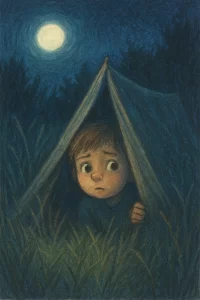
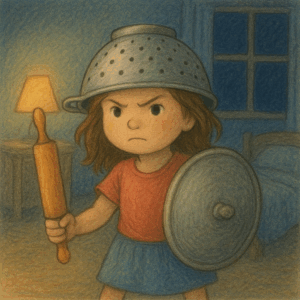
Here’s a story for children all about courage. It’s reminded me to take a moment when I’m scared and listen to my heart.
Courage comes from the Latin root for heart. It’s not about being a fierce fighter, able to vanquish all foes. It’s about being connected to one’s heart, such that one’s relationship to fear can change.
I’ve noticed that when I get scared of someone, I have a tendency to harden against them. I close my heart, and judge them.
Courage invites an opposite movement. I pause, take a breath, and notice how I’m feeling. This brings the possibility of looking at things differently, of seeing the other person with curiosity, compassion even. I feel like I have more choice, more agency and more creativity when I can remember to do this.
This story offers this teaching in simple terms that a five year old could understand. It’s something that many of us could benefit from remembering however, myself included.
Play here or: Play in new window | Download
Subscribe: | More

Here’s a story for children all about self-expression.
Children are born crying and things carry on from there! Babies express, just like the rest of us, with the awareness and knowledge that they’ve gained so far in life.
But it’s a tricky dance, to express oneself fully and in such a way that other people are willing to listen to us. Too loud? They might find us annoying, and switch off. Too quiet? They might not notice us.
Sadie, the main character in this story, starts off at the loud end of this spectrum. If she’s happy, she sings; if she’s sad, she cries; if she’s angry, she yells. And that’s just when she’s a baby!
Eventually Sadie quietens down, but not in a good way. Bullies at school shut her down until she barely speaks at all. And that’s when her problems really begin.
Sadie and the Monster tells the story of what happens when we repress our natural need to express ourselves: our inner world fights back! A monster comes to Sadie, speaking with the voice of the bullies at school who shut her down. Rising to the challenge, Sadie finds the power to make a different choice. She learns to express herself with consideration for her listeners; to be aware of how much people can take in, and also be curious about what’s going on for them.
By the end of the story, Sadie is back to being fully expressive of everything that’s going on inside her – but she’s learned a subtle art that many adults struggle to master. She finds the words and the strategies to express the fullness of her experience in ways that others can enjoy. This kind of expression is more accurately called sharing, and it is how our inner experience can be a gift for the people around us.
It’s sad that so many of us never learn this art. Fully expressing our inner life is a vital need. Failing to do so can mean that we can become a stranger not only to the people in our lives, but to ourselves. I hope this little children’s story plants a seed that reminds children of how much this matters.
Play here or: Play in new window | Download
Subscribe: | More

Here’s a story for children all about faith.
I’m not talking about religious faith, but rather the power that faith has to pull our dreams to us.
Sometimes the things that we most want can seem so far away from us. It takes courage to allow ourselves to feel the depths of our longing for them. But it’s by following that longing that we take the steps necessary for our dreams to come true.
None of this philosophising is in the story, however. It’s rather a simple story about a young woman who keeps on having dreams of a cafe by the sea. Mysteriously, she has an overwhelming sense of knowing about this cafe: some day, somehow, she’ll be running that cafe, and it will be wonderful.
So she goes looking for it.
She drives her car to all the nearby beaches, and then the ones further and further away. But still she doesn’t find it.
So one day she takes her car to the garage.
“My car doesn’t work!” she said.
The mechanic just stared at her. “Well, what’s wrong with it!” he asked.
“It just doesn’t take me where I want to go!” she replied.
“Oh silly me” he thought, “well I guess that’s obvious then”. And he told her that he’d see what the problem was and have it ready for her to drive away the next day.
But there was nothing wrong with the car. He checked all the systems and they were working just fine. When she came back the next day, he didn’t know what to say. But when he heard her story and understood the depth of her longing, something mysterious happened to him. He wanted her to find her cafe, and offered to help her do so.
That seems to be how life works. By naming what we really want and claiming it, we bring it closer, in some mysterious way. Events, people, everything conspires to bring our dream to us.
It takes them a long time to find her cafe, but they do so in the end, although in a most surprising and unexpected way. It would seem that the fulfillment of our dreams only comes to us only when we’re really and truly ready for it.
You can listen to the story here.
Play here or: Play in new window | Download
Subscribe: | More
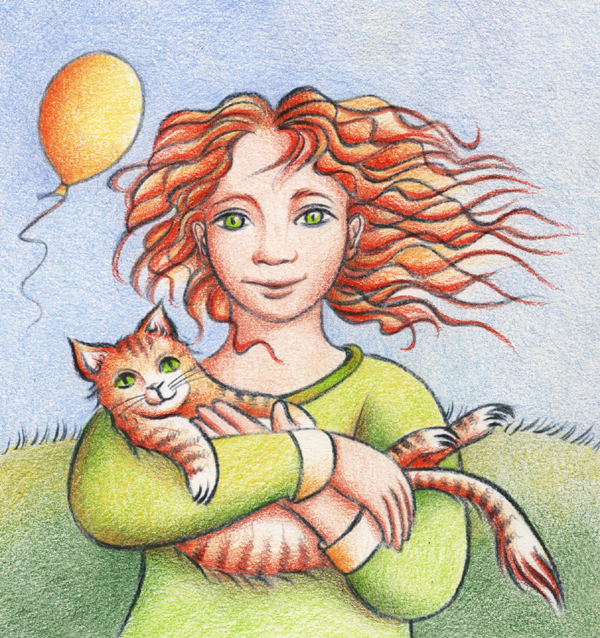
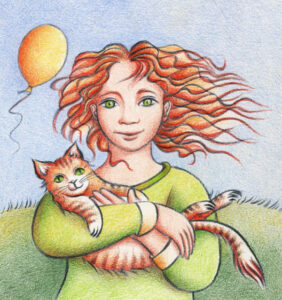
One day Molly let go of her treasured balloon and off it went, bobbing in the air. By the time she’d realised it was gone, it had already floated far, far away from her. To catch it she would have to run faster than she’d ever run before and ask for help from all the people she met.
Molly is a sweet, innocent girl and she brings the best out of everyone she encounters: a couple arguing over whether to have another child, a young woman dreaming of being a doctor, a gardener grieving the loss of his marriage and a wealthy woman living in isolation. In each case, Molly’s mere presence sparks in them a remembrance of what most matters in life.
Maybe that’s why we love children. Of course, there are strong instincts involved, but who is to say where instinct ends and soulful qualities begin? Their beauty evokes our desire to love and care for another. Their innocence reminds us of our own capacity to be deeply touched by life.
When I started learning to meditate, I was advised to look for a space of stillness inside. It took me quite a while to find it but when I did, I realised that I had known such a place before.
One of my very earliest memories is of being on holiday with my family. I was waking up from a nap in a room that was unfamiliar to me, and yet I felt intimately and deliciously at home. A sublime peace and stillness pervaded my experience, and I saw the world around me as beautiful beyond words.
Maybe Molly stands for that place in us all. As she walks through her story, she reminds everyone in it of what really matters in life. Maybe when we cultivate that level of innocence and presence in ourselves, we can remind ourselves of what really matters, too.
You can listen to the free audio recording below.
Play here or: Play in new window | Download
Subscribe: | More

There’s a lot of talk about how powerful it can be to tell our own stories. The value of sharing personal stories is now well established in therapeutic settings. Whether in circles of people recovering from abuse or drug addiction, sharing one’s personal story with people who can empathise with our struggles is clearly a very healing thing to do.
But there’s also value in recounting the most significant POSITIVE experiences of our lives. Most of us do this spontaneously. Something wonderful, or even miraculous, happens to us and we want to share it with our family and our friends.
But some experiences are so important that even telling them a few times like this doesn’t do them justice. I’ve written a whole series of articles about the most magical, weird and wonderful happenings in my life. It’s one way to remember them, and to savour them. My wife Sundara keeps folders that she fills up with fliers for performances that moved her, pictures of people that made a big impression on her, and of places whose beauty wove itself into her heart.
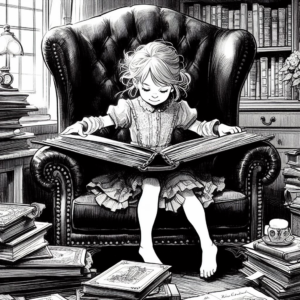
It was watching her at work on her latest folder that inspired The Beauty Book. The grandfather in the story keeps such a book himself and the storytelling happens between him and his granddaughter. She happens upon him, reading through this repository of meaningful moments, and wants to know what he’s doing.
What then unfolds is the magical heart of this story, as the grandfather goes through each page, telling his granddaughter the story of each photograph, sketch and poem. It’s the sharing of these memories that becomes so touching for them both. The young girl starts to live into the old man’s life; the old man gets to relive those memories in a totally new way. It’s a moment of pure transcendence.
But then her grandfather does something which surprises the girl – he takes out a sketch pad, makes a sketch of her, and puts it into the Beauty Book! For him it’s simply the latest memento of a beautiful moment. But for the girl it’s a puzzle. “Why would he make a picture of me, just reading his Beauty Book? What’s so beautiful about that?”
We all long for empathy; to be seen in our essence. It’s striking to me that so many scenes in romantic movies depict the first moment of attraction this way. Two people sit together and one of them shares something deeply significant. Often it’s a creative talent they have, but it could also be a story from their lives. As this precious piece is shared they are vulnerable, searching the eyes of their listener for signs of empathy. When the empathy comes, the magic begins! The other person sees them, in a way that they long to be seen.
Telling precious stories from our lives is thus a way to recover the lost pieces of our soul. This world, which can be so harsh, has nonetheless at times touched us to the core. In those moments, the fullness of who we really are can live and breathe here. That can be a rare experience for some of us, and definitely one worth savouring. As we piece together such moments, we’re like a character from an old folktale, stitching together a patchwork coat of meaning and remembrance.
The girl in the story only answers her question when, many years later, she shares her own Beauty Book with her daughter, and realises what a transcendent experience such storytelling can be.
Sundara and I made a studio recording of The Beauty Book, and you can find it here. I’m playing appalachian dulcimer, guitar and sansula, and Sundara plays the handpan.
Blessings,
Leo.
Play here or: Play in new window | Download
Subscribe: | More

Whenever something really challenging would happen, the girl always knew what to do. She’d grab some paper and pens and draw the same shape, over and over: a heart in multi-coloured lines that would express her overwhelming feelings.
One day, many years later, she rediscovered those pictures, and was able to recount each story in detail, recalling the strong emotions that her drawings expressed. It was something she needed to do, before opening her heart to another.
Our bodies store these moments of unprocessed emotion, and in the story the girl finds an old wardrobe at the back of the garden shed, and stuffs all her pictures in there. But our bodies never forget. Unless we can integrate these experiences, our hearts will register the blockage. Fear will hold us back in subtle ways, stemming the amount of love we can give, and receive.
This has been my experience again and again. Revisiting and healing those places that are still hurting enables me to return to life more committed to love; willing even to experience more hurt, if that’s what it takes to keep my heart open.
This is a short, sweet children’s story, and even a five-year-old could follow its logic. But it traces a shape that lives in all of us, and outlines the ways we can take care of it.
Play here or: Play in new window | Download
Subscribe: | More

Here’s a story for children all about cultivating intuition, even in trying circumstances.
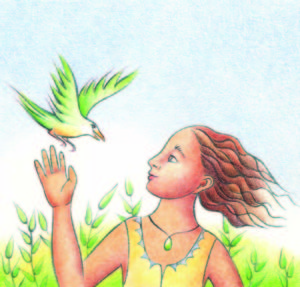
The girl who is the story’s hero finds a little bird following her around all the time. Wherever she is, whatever she is doing, this little bird seems to want to get her attention.
But although she tries to fathom what it has to say, she cannot understand its singing. Meanwhile, her friends have noticed her talking to a bird, and start making fun of her. Her teachers scold her for being late for her lessons. She’s getting into trouble, but she really wants to find out what this bird is trying to tell her!
When she finds out, the bird’s message is shocking. The volcano that the tribe lives beneath is about to erupt! Everyone must pack up and leave, or face disaster…
We live in crazy, crazy-making times. I wonder what our young children are absorbing from the culture they are growing up in. It seems to me that anxiety about our world is growing in us all, like a steadily growing static.
What to do about it? My hunch is that the best way for us to navigate our many crises is by tapping into the potential we all carry – for greater insight, creativity and wisdom. And one way that we can do that is by developing intuition. That means becoming porous to the larger intelligence of which we are a part. It can look a bit crazy, like listening to a bird, but I’m sure it will be key to our survival.
This story doesn’t actually talk about intuition, and the girl just listens to a bird. But her insights save the tribe and teach them how to thrive in their new home. Sundara and I play several instruments to accompany the story – guitar, handpan, whistle, dulcimer and sansula. You can listen to it below.
Play here or: Play in new window | Download
Subscribe: | More

Here’s a story for children all about generosity.
We live in a world of extreme wealth disparity, with some people having huge material abundance, and others unable to meet their basic needs. It’s unfortunate that this is the world that our children are growing up into, but it’s important that they find open-hearted strategies for dealing with it.
This is where stories can be helpful. By introducing unfamiliar challenges and then demonstrating how to navigate them positively, a good story gives children tools for a happier life.
I’ve dedicated my life to this hope – that present and future generations of children can find ways of thriving as they grapple with the immense challenges that humanity is creating for itself. Thriving means sailing with the winds of change rather than being capsized by them. How do children learn such strategies?
When children are small, their parents can make choices about the sort of stories they absorb. I’ve no idea how much this helps, but I do believe that everything helps! Every kind word, every affectionate hug, every story that leaves them with positive strategies for navigating life.
So here’s The Farmer’s Gifts. It’s all about a farmer on her way to market with her cart overflowing with produce to sell. By the side of the road she encounters a young girl, close to starvation. What to do? How best to help?
It turns out that the more she helps, the more magic starts to unfold in her own life. The story becomes more and more miraculous until her whole community is transformed.
And all this from some simple, kind acts? Well, why not? Deep in my heart, I know that love is the most powerful thing in the universe. If there’s anything that can see us through life’s earthquakes, it is love. So let’s have stories all about how powerful love and generosity are!
My wife Sundara composed some beautiful music to accompany this story, which brings all that magic to life.
You can listen to the free audio recording below.
Play here or: Play in new window | Download
Subscribe: | More

Stories are pure magic! The right story at the right time can change the course of a person’s life.
Here’s a story for children all about this magical power. It all starts when a girl discovers an old woman living in the forest in a cottage filled with magical gems.
“What’s so magical about them?” the little girl asks.
“Each one is filled with stories,” replies the old woman.
“Stories?” said the girl. “What’s so magical about stories?”
But she soon finds out, when the old woman gives her a gem for her mother.
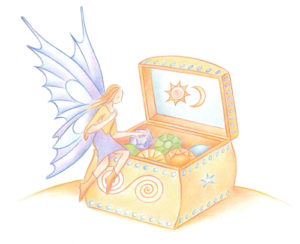 The girl’s mother, you see, was scared of spiders. But the stories that the gem tells are all about how lovely and sweet spiders can be. Soon her mother is looking forward to the latest “spider story”. And then one day, when a spider comes walking across the kitchen floor towards her, instead of shrieking she crouches down and says “Aww, look at you! Where are you off to, then?”
Magic! Soon the little girl is returning to the old woman’s cottage for more gems. And so it goes for the rest of her life. Whenever she or someone in her life needs healing or inspiration or comfort, she goes and asks for another gem, until she herself is an old woman, living in a cottage full of magical story gems!
My wife Sundara joined me in creating a musical accompaniment to this story, playing handpan, whistles and other instruments. We performed it last autumn in The Dragon Sanctuary, our arts hub in Devon. You can find a studio recording of the story below.
Play here or: Play in new window | Download
Subscribe: | More
I recently listened to all the stories on Palace of Stories. It was at times a gruelling experience. By the time I had finished, 40 of the 125 stories on the site had been ditched.
It’s always difficult to listen to material that I thought was good at the time, but now doesn’t pass muster. However, removing those stories is usually more of a relief than a sadness, as I only want to have the best stories up there.
But another challenge came up this time, which I hadn’t expected. I realised that there was a strong imbalance in the gender of the protagonists of the stories. Of the 85 stories that survived the review, 57 had male protagonists whereas only 28 had female leads, a 2:1 ratio! How did this happen?
Where to start?
When I started storytelling back in the late 1980s, awareness of gender representation was less mainstream than it is now. I was slow to notice just how fast things were changing, but having a daughter in 2007 (who is now a very self-aware teenager) has helped me to catch up fast.
 Folk tales come from the world of the distant past, with its traditional gender roles. At the beginning of my storytelling career I immersed myself in that world by reading thousands of folk tales. Reading and retelling the old stories seemed to me the best way to get an authentic and grounded sense of what storytelling had meant to our ancestors, and what it could mean for us today.
But even when I’d branched off into telling intuitive stories, I largely stuck with that old-fashioned context. So I’d still tell more stories about blacksmiths and carpenters, knights and tailors, than I did about witches and princesses, as there were many more roles for men to play in that world. Being a man myself probably also helped skew the gender of my protagonists, as well as the fact that, for various reasons, my son heard more of my stories than my daughter. But enough excuses, I’m just embarrassed and sad to see how my heroes far outnumber my heroines.
Disney’s Mea Culpa
Over the last few decades I’ve watched the Disney corporation go through a fascinating process of re-evaluating how females are portrayed in their children’s movies. Their “golden age” movies are still much loved (Snow White, Sleeping Beauty, etc.) but if anything they made the gender imbalances inherent in their source material even more pronounced.
One of my favourite movies from this period of re-evaluation is Enchanted. Made the year my daughter was born, it looks at times like a public apology for the gender stereotyping of their earlier classics. Since then, they’ve released a string of excellent movies featuring strong, courageous, powerful, intuitive, brilliant and big-hearted heroines.
My own Disney Moment
I’m belatedly having a similar moment of my own. As my review proceeded and more and more stories were being stripped out of the catalogue, I realised that to replace them I’d need to record about 15 new stories (Palace of Stories always has 100 stories or more).
I went back to unproduced recordings of the best bedtime stories I told to my kids when they were young, as well as newer material that was also awaiting re-recording. Wherever I could, I changed the protagonist’s gender to female.
I now realise how attached I’ve been to the world of those old folk tales, believing that the long-lost medieval past was somehow a more magical setting for a children’s story than the more complex world we live in today. But the time is long past when stories could largely be about boys and men doing courageous things, while the girls and women look on. The girls of today, and of generations to come, need better than that!
So here’s The Jeweller and the Simple Stone, which began life with a male jeweller, somewhere in medieval Europe. In its new telling, the Jeweller became female, and the setting could be anywhere! You can listen to the audio story below.
As for the stories I’m now telling, I’m seeking to create characters, female and male, that both girls and boys can be inspired by. If you live in Devon, you might want to come along to the performance that I’m giving with Sundara in December. As it happens we’ll be telling another two stories involving jewels, in our show Magical Gems and Mystical Jewels.
And I’m pleased to say that all of the protagonists are female!
The Jeweller and the Simple Stone can be found here.

I used to buy books on astronomy and do my best to fathom the vastness of space. It’s not easy. The best books try and take you by the hand and scale things up step by step. But even then it’s impossible to keep pace. The vast reaches of the universe are just too huge to imagine. At some point my mind gives up trying to encompass it all.
 But it’s at exactly that point that something wonderful happens: awe awakens. If this universe that we live in is just SO vast that not even our prodigious imaginations can fathom it, then awe is all we are left with. And awe is an open door to wonder, mystery and magic. When we are in awe, we are in a place of not knowing and that is the key to discovering the vastness that exists inside us.
Our minds like to know, to set everything in rows and order the world we see. But beneath this effort lies a vast sea of consciousness. This is the essence of who we are, the fathomless ocean of being out of which we are born, and of which we are the full inheritors.
Each of our attempts to know our world reduces this vastness to something more manageable. Now we can feel like we are in charge, but we’re not really. Each step along this path of “I know, I can control” takes us further and further away from awe, from the open door inside that leads to our own vastness.
I wanted to create a story for children that would speak to some of this, and you can find an audio recording of the story my intuition brought me below. It speaks of a little mouse who, living in the little cage in her owner’s bedroom, thinks that this bedroom is the whole world. Stage by stage, she is shown how large the universe is, before being brought back home to her little cage again.
And the way she travels is awe. “Oh wow! Oh wow! Oh wow!” she says, as first an eagle, and then an angel show her the vastness of her universe. Her curiosity draws her ever onward, until her heart calls her to return to Earth. “Ah…. home at last!”
There’s something paradoxical about the way this story ends that still tickles me. Yes, we are the inheritors of a vast and brilliant universe, and a vast and brilliant consciousness. But in the end we are best suited to working with what is just here, with what we can see and touch, with what exists at our own scale.
But I feel deeply that we manage this daily life best when our hearts are open to the wonder and beauty of it all – to the vastness that this smallness both conceals and reveals. And we find our way to that kind of living when “Oh wow!” is our mantra and awe is our compass.
The story can be heard here.
Play here or: Play in new window | Download
Subscribe: | More

Here’s a story for children all about loss, that shows how to navigate these intense life circumstances while keeping our hearts open.
We are all destined to lose everything that we love. For some of us this will happen all in one sudden moment, at death. For others, the dying process will be so prolonged that many of the things we most loved in life will fall away one by one.
But some of the hardest losses hit us in the prime of life, typically when a loved one dies or disappears from our life. Now we need to cope with loss in a different way.
Being present to the intense emotions that arise at these times is the key to keeping our hearts open. It’s when we shut down, pull back from the intensity of the grief, wall it (and ourselves) away in some hidden place, that we live our lives as if hobbled. The grieving process has not been allowed to run it’s course, and our hearts will be constricted until this happens.
In the story, two close friends are separated by circumstances. The loss is unbearable for our protagonist, Anna. She’s unable to cope, literally walling herself off in her bedroom, unable to communicate with her mother. It’s only when her mother takes her to an older woman who has faced grief with an open heart that Anna finds a way to stay open to life, and the love relationships that will inevitably flow in and out of it.
Staying open to love is an art. It requires that we recognise that we have no choice about what happens to those we love. We ultimately can’t even control our small children, let alone our older ones! But we can choose what happens to our hearts.
 Love is internal, not external. It is not located in the body of our lover, the wellbeing of our children, the warmth of our friends and family, but it finds a reflection there. In these love relationships we can experience the deep satisfaction of the love in us flowing out into form, blessing and caressing those we most love. That’s wonderful, and while it lasts we can feed that experience with gratitude.
But when it stops, we need to find ways to grieve. The old lady in the story gives Anna a little bush, and tells her to plant it in the garden of her new house. Every time she feels the loss of her friend, Bella, she should go out to the bush and speak to it as if Bella were there.
Anna finds herself going often to her “Bella bush” and letting the words flow, and the tears fall. In time the bush has grown large, and its sweet fragrance has become a calming presence for her. She still misses her friend, but peace has replaced sorrow. And then, just when she’s ready to leave home and go to university, she gets a call from Bella…
You can find the story here: Anna and Bella.

Here’s a story for children all about losing and finding. Although it’s a colourful tale all about a Princess and a Peddler, it actually has an underlying message that goes deeper.
We are all from a larger place. We all emanate from a consciousness far vaster than the one with which we live here on the Earth. This story talks in metaphorical language about this loss, the awareness of which lives inside each one of us.
 Losing our “true home” in this way is one of the central traumas of being human. It lodges inside us, deep down, sometimes manifesting as feelings of shame, or guilt, or having done something wrong along the way.
But nothing wrong has happened. The “fall” to Earth, that spiritual beings take in order to enact profound learning they couldn’t come by elsewhere, is entirely intended. The density of this world, the immense challenges it places upon us in multiple ways, is all part of the plan.
Forgetting is the hardest part of this, however. Forgetting that we are, and have always been, a radiant spiritual being who is just here for a short time, and who has a far vaster context in which to play out our intended evolution.
Remembering, then, is the sweetest of all blessings. Remembering that we are not ultimately limited by our Earthly circumstances, however heavily they seem to press upon us. Remembering that we have done nothing wrong and that all our “mistakes” are just twists and turns on a long journey home.
Forgetting and remembering works quite well as a theme for a children’s story, because children are always forgetting things! It’s one of the things that newly born spiritual beings struggle with in the transition to living as a human being on the Earth. Here, “things” are extremely important (especially in our culture) and learning to take care of them is vital. All children have a challenge with this, and take years to properly take care of their possessions (I have teenagers who are still working on it!).
In it, two women from very different backgrounds aid each other in remembering – one that she is actually a noble Princess from another land, and the other that the most important thing is to love and honour the people and places most important to us.
You can find the story here: The Peddler and the Princess.

Where is magic to be found? In what you are already familiar with?
No, magic turns up where you least expect it. Have you ever noticed that if you are really, really searching for something, you think you see it out of the corner of your eye? Your room is suddenly filled with this thing, just around the edges of what you know.
This is a simple little story for children that uses this phenomenon as a metaphor for something larger. Because life can be like this too: if we really search for something, sometimes find it in the least expected places.
 Intuition also works this way. Intuition works around the edges of what we know. Indeed, to expand our capacity to receive intuitive information we need to intentionally become comfortable with “not knowing”, being skeptical about that part of us (our rational mind) which thinks it has all the answers.
Letting go of this most prized faculty can feel scary, like falling from a place of safety. But it is a necessary step towards living in a more intuitive way. Now life can find us on its own terms. Being open to the unknown, we are more available to life. This is how magic comes to us, not from what we can see straight ahead of us, but out of the corner of our eye!
The story tells of a boy who discovers this unusual phenomenon and takes it one step further: now when the teacher asks him questions at school, he only needs to stare hard at the blackboard and the answer will appear to him out of the corner of his eye!
When his girlfriend needs comforting, instead of trying to figure her out, he just lets his words come from this place too, with much happier results.
Eventually the boy realises that this is where magic comes from and decides to become a wizard. “All my best spells came to me out of the corner of my eye!”
You can find the story here: Where Magic Happens

Here’s a story for children about the importance of honest leaders.
A King came to a blacksmith’s forge. Handing him a large lump of gold, he asked the blacksmith to make him a crown for his son, saying he would return in a month.
But a whole year went by, and when the King finally returned he reported that he had been unable to find his son.
“I didn’t realise you were looking for him,” said the blacksmith. “You must be very worried!”
The King shifted uneasily. “Well, you see the truth is that I don’t actually have a son, but I am looking for one. I need to find an honest man who can rule my Kingdom wisely when I am gone. No such men existed in my own Kingdom and that is why I came looking here.
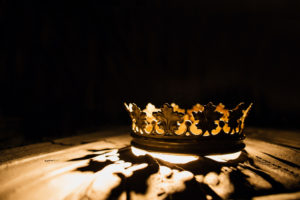 “But I find to my dismay that the people of this Kingdom are as dishonest as the one I just left. So now I’m going home, and I’ve no idea what I’ll do next.”
The blacksmith watched him turn to go, “but you can’t leave without the crown!” he cried. “Look, I’ve been keeping it for you!” And he ran up to his attic and brought down the most beautiful crown, in its own makeshift box.
“When you didn’t come back I thought something dreadful must have happened, but I kept the crown hoping you’d return for it eventually. Here! You must take it with you now.”
The King stared in wonder at that beautiful crown. Such a marvel! Such a treasure! And then his gaze slowly lifted to the man holding the crown. Such a marvel! An honest man! He had disappeared for a year: a less honest man would have melted the gold down and sold it off, but not this one!
“I wonder…” said the King. “If you would like to be my son….?”
Honesty creates its own rewards, and a story like this shows that this is how the universe actually works, even though it doesn’t always seem that way here.
Lying and cheating may bring material advantage, but our hearts are left empty. Only honesty opens the doors to the real treasure in this world, which is love and connection.
I wish all our leaders were selected on the basis of honesty.
You can find the story here: The Blacksmith and the King’s Crown

When the lockdown started, the words I often heard people using were “scary” and “frightening”. A few weeks later the word pinging around in my inbox was “bizarre”. Currently it looks like “the new normal” might be the phrase.
I’m having a good lockdown. My current lifestyle isn’t that different from usual, as I already work from home. In some ways I feel more comfortable now – no longer such an outsider, watching the busy world go by. Now everyone has joined me, at home.
And then I got the virus.
It didn’t hit me as hard as other people, and my symptoms stayed within the “mild” range throughout. But it was nonetheless a pretty tough virus to deal with – for several days it felt as though I had something nibbling away at my lungs from the inside, a very strange experience! And yet there was also something very interesting about getting an intimate, first-hand experience of this virus that has stopped the whole world in its tracks.
I’ve heard many people say how good it is that humanity is pausing like this. One of the most interesting comments came from a friend who said that evolution often works this way: a species needs time to pause and “catch up with itself” before taking the next big evolutionary leap.
 For myself, I felt a wave of energy sweeping through me as the crisis began. The spiritual group I belong to – the Bright Path Ishayas – started offering three online meetings a day for people to practice and share together, almost like an emergency effort to support people to take the crisis in the best possible way: not as a reason to panic, but as an opportunity to be more present than ever.
In those early weeks, it did indeed seem that humanity was in danger of collectively tipping into fear and panic. The response of spiritual practitioners the world over has been to double down on our practice, and share an alternative response.
It was during that time that I created a story for children. All those kids, suddenly locked up indoors, perhaps with adults who were quietly freaking out at the state of the world: I wanted something for them.
So I asked my inner storyteller for a story about how inner peace can overcome fear, in any circumstances. The story I received is all about a spice merchant who travels as far south as he can, to find a remedy for fear and panic.
You can find the story here: The Merchant and the Spice of Fear

Here’s a story for children all about that within us which cannot be destroyed.
It tells of a girl whose hair cannot be cut. Although creating havoc in her family and early relationships, this strangely resilient (and eventually very long!) hair proves to be her blessing. It shows her how to live purposefully, and at the end of her life is her comfort and her gift to the next generation.
Our divine nature is not always seen or celebrated by our family, our friends or even our lovers. Some of us might choose to hide it, or cut it out of our awareness. But Claire doesn’t have this option. Her soul-essence stays visible, frustrating her parents wishes for her, and spooking her first boyfriends.
By going on a journey to discover why her hair can’t be cut, she discovers what it’s really for. Now struggle can turn to inspiration and she finds a place in the world for all of who she is. I especially like the scene at the end of the story where, as an old woman, she sits by the fire weaving and reweaving her hair into a cloak. “And whenever she wore it, she felt that no trouble could ever touch her. She could go outside in the wildest of weather, and always feel safe and warm inside.”
So must our soul feel at the end of a lifetime in which we kept it close and learned what it had to teach us.
I’ve recorded this story with my wife Sundara playing the handpan. I love what she can do with this magical instrument, which sounds like it was forged in story-land.
You can find the story here: Claire’s Unbreakable Hair

When I was a child my mother would buy a big Christmas tree every December and we’d all decorate it with baubles, tinsel and fairy lights.
One Christmas eve, aged fourteen years old, I took a walk outside in the misty London streets. It was so late that there was almost no traffic. On the night before Christmas, the city seemed finally to be resting.
The house was quiet when I returned, and as I sat down in the living room and gazed over at the shining Christmas tree, something completely out of the ordinary happened.

A door opened inside me to an astonishing state of being that held me riveted for a long, long time. A state of reverence, awe and magic had spontaneously arisen inside me. It were as if those fairy lights had evoked the sacred inner light. In the years since that night I have become a seeker, and lately a lover, of that radiance.
And here we are again in yet another December, and as I approach the latest Christmas of my life there is, as always, a tone of sadness about what Christmas has become. Here in Britain, as in many places, what was once a celebration of light seems to have become mostly about eating, drinking and shopping.
When my kids were young, my wife and I tried to do things differently. Every year we’d retell the advent story with home-made felt puppets. We’d bake things, make things, sing lots of carols and tone down the presents.
This was the period in their lives when I would tell them a new story each night at bedtime, and one December night this one came through. Listening to it again now draws me back to that moment of awe and wonder that I had in my youth.
Once there was a bus driver whose bus was always full of passengers. It only got worse at Christmas, when people would clamber on with their huge bags of shopping. Sometimes there was barely standing room.
One cold December morning, however, something very strange happened: the streets were all deserted.
There was no traffic, and nobody was waiting at the bus stops for him. A thick mist hung in the air and everything seemed strangely dream-like.
“Where is everyone?” he wondered as he drove through the empty streets past one empty bus stop after another.
Finally, however, he saw a passenger waiting in the mist. “At last!” he said.
But as he approached him, he found that this was a most unusual passenger. He was a young man with long dark hair, dressed in a white robe and sandals. He looked vaguely familar, but the driver couldn’t place him.
The young man took a seat near the front and as he drove on something magical came over the bus driver: a sense of calm, of deep peace, and the most wonderful sense of purpose. It felt to him that this was the best thing he’d ever done in his life, driving this strange young man through the deserted streets. Indeed, it felt like this was what he had been born to do.
When the young man got off at his stop, the driver said, “excuse me, but do you have any idea why there’s nobody around?”
The young man smiled, “because it’s my birthday!” he said, and walked off into the mist.
“Your birthday?” spluttered the bus driver, and then he looked at the calendar that hung next to his seat. “Then… you must be Jesus!”
The bus driver ran out into the mist, shouting for him. But he was nowhere to be seen.
Returning to his bus, however, he found a small present on the seat where the young man had been sitting.
He went home, made himself some Christmas dinner, and then opened his little present.
Inside was a little golden bus, an exact replica of the one that he had driven that day. The driver looked very much like himself, he thought.
When he went back to work, he took that little golden bus with him in his pocket, and from that day forth, everything was different. A deep peace filled him, and a deep sense of purpose too. Every passenger seemed special to him, no matter how full the bus was.
In time he came to bless the day he had driven his empty bus through the mist on Christmas day…
I wish Christmas could always be a time of spaciousness and magic; of creating enough space on the bus that the inner light could return to us and remind us of the deeper purpose of our lives.
You can find the story here: A Christmas Story
And if you are all shopped-out but are still stuck for presents for someone small, you can find 100 more stories on Palace of Stories!